Peptide purity testing is an analytical process that measures what percentage of a peptide sample is the actual target compound versus impurities such as synthesis byproducts, truncated sequences, or residual reagents. In research, this number is not a marketing figure. It directly determines whether experimental data is reliable. A peptide carrying even a small percentage of unintended substances can bind off-target receptors, interfere with assay reagents, and make results impossible to reproduce. If the compound going into an experiment is not confirmed pure, nothing coming out of it can be trusted.
Understanding Peptide Purity Testing
What does peptide purity mean?
Purity is expressed as a percentage of the target peptide relative to everything else in the sample. A 99% purity rating means 99% of the measurable content is the intended compound. The remaining 1% may consist of oxidized variants, acetylated byproducts, truncated synthesis fragments, or residual solvents. In quantitative assays or receptor studies, that 1% is not inert. It can produce false signals, reduce apparent potency, or mask real responses entirely.
How Is Peptide Purity Testing Done?
Two analytical methods form the industry standard for peptide purity testing.
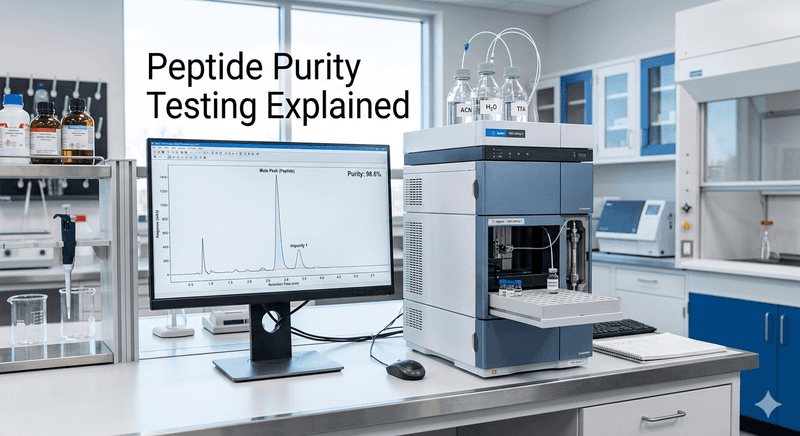
HPLC (High-Performance Liquid Chromatography) passes a dissolved peptide sample through a pressurized column. Each component in the sample separates based on its chemical affinity for the column material and elutes at a different time. The instrument records each component as a peak on a chromatogram. The area of each peak represents its proportion in the sample, giving a direct purity percentage for the target peptide.
Mass Spectrometry (MS) confirms the molecular identity of the compound. It measures the mass-to-charge ratio of ionized molecules to verify that the main HPLC peak is actually the correct peptide and not a co-eluting impurity. HPLC tells you how pure the sample is. MS tells you whether the compound is what it is supposed to be. Used together, they provide both a purity percentage and molecular identity confirmation on the same lot.
Why Does Third-Party Testing Matter?
Manufacturer self-testing creates a direct conflict of interest. An independent third-party laboratory has no financial stake in the result, operates under controlled analytical conditions, and issues a Certificate of Analysis (COA) that can be independently verified. A valid COA should include:
- The peptide name and sequence
- Lot number and test date
- The name of the testing laboratory
- An HPLC chromatogram with purity percentage
- MS confirmation showing observed versus theoretical molecular weight
Any COA missing these elements cannot be used to verify quality. Researchers sourcing lab-tested research peptides should request a lot-specific COA before use, not a generic document covering all stock.
What Do Peptide Purity Test Results Mean for Research?
Is 98% purity good for peptides?
For most standard research applications, 98% is an acceptable threshold. At this level, impurity-driven signal interference is low enough for general assay work. However, for high-sensitivity applications such as receptor binding kinetics, dose-response measurements, or in vitro cell studies, 99%+ purity is the appropriate standard. The difference between 98% and 99% may appear small, but in quantitative experiments it translates to measurably less background noise and fewer off-target interactions.
Is 95% purity acceptable?
95% purity is borderline for research use. It may be sufficient for preliminary screening where precision is not critical. For any experiment generating publishable data or informing downstream decisions, it introduces too much variability. The 5% impurity fraction can interact with biological targets and produce results that look real but are not reproducible with a purer batch.
How can I test my peptides for purity independently?
Researchers can submit samples directly to independent analytical laboratories offering peptide characterization services. These labs run HPLC and MS on submitted samples and return a full report. This is standard practice when sourcing from unfamiliar vendors or when batch-to-batch consistency needs to be confirmed across a research program. Cost varies by lab and method, but most independent HPLC and MS panels fall in the range of $100 to $300 per sample.
Conclusion
Peptide purity testing is a non-negotiable quality control step in research. HPLC establishes the purity percentage. Mass spectrometry confirms the compound is correct. Third-party COAs verify both without a conflict of interest. For most research applications, 99%+ purity is the appropriate requirement. Below 98%, data quality becomes a real concern. The COA should always be reviewed before a peptide enters any experiment, not after results raise questions.
Frequently Asked Questions
What does a purity test mean for peptides?
It measures what percentage of the sample is the actual target peptide. The rest is impurities from synthesis, degradation, or residual chemicals. Testing is done via HPLC, mass spectrometry, or both.
What is a good purity for research peptides?
99%+ verified by HPLC and mass spectrometry is the standard for serious research. 98% is acceptable for general applications. Anything below 95% should not be used in quantitative or publication-grade experiments.
Is 98% purity good for peptides?
Yes, for most standard work. For binding kinetics, dose-response studies, or cell-based assays requiring precision, 99%+ is the better threshold.
How can I test my peptides for purity?
Send a sample to an independent analytical laboratory. They will run HPLC and MS analysis and return a report with purity data and molecular identity confirmation.
How much does peptide purity testing cost?
Independent HPLC and MS testing typically ranges from $100 to $300 per sample depending on the laboratory and scope of analysis. Reputable suppliers include third-party COAs with every lot at no extra cost to the researcher.
How to know if peptides are good quality?
Request the lot-specific COA before purchase. Confirm it is from an independent lab, includes an HPLC chromatogram and MS confirmation, and is dated to the same batch you are receiving.